
Member Spotlight — Vicki Jackson Awarded OAM
In this edition of RoundTable, we are fortunate to chat with Rockhampton family lawyer Vicki Jackson OAM.
Awarded an Order of Australia for services to the law and the local community in January this year, Vicki is no stranger to accolades. She is the 2014 recipient of the QLS’s Agnes McWhinney Award (recognising a female lawyer who has forged new pathways for themselves or others through a commitment to excellence, equity, professionalism and service to the community) and the 2016 recipient of FLPA’s Travis Lindenmayer Award.
Still loving her work after almost 50 years in the profession, Vicki chats with RoundTable about her career, her love of horses, and reflects on the family law profession and how it has evolved.
Tell us how you came to choose a career in family law?
I did not choose family law. It found me. I happened to study family law in 1975 so then partner at South Geldard, Tom Carmichael, who undertook family law under the former Matrimonial Causes Act decided I could share the load on family law under the new legislation. Ultimately, he retired and I got landed with responsibility for it.
On reflection, would you have rather done something else?
Having undertaken articles of clerkship at a regional law firm, South & Geldard, I was exposed to several areas of the law so, in addition to family law, I have embraced and enjoy ‘agri-business’ be that rural property contracts, succession planning, share farming agreements and disputes as well as probate work.
Under the guidance of Tom Carmichael, I even practised in personal injury work in pre-PIPA days when there was a lot of court work. This gave me excellent exposure to the courtroom and an opportunity to instruct very good barristers in the civil jurisdiction all of whom were later elevated to the bench such as Fred Maguire, Stan Jones, Robert Hall, Grant Britton, Duncan McMeekin. I learnt so much about evidence and courtroom etiquette not only from Counsel but also Tom Carmichael – his hard copy of the Supreme Court Rules was like my grandmother’s bible – all marked and well used. I enjoyed and continue to enjoy probate work.
This broader experience has also benefited my family law practice. Being able to read balance sheets among other things has made it easier for me to understand a client’s position.
Who has influenced you most in your career?
Those who influenced me in my career were of course, my master Robert South who had a practical business mind and always looked for a solution for clients. Robin Geldard was a wonderful mentor as he had a sharp mind and an interest in the law (I recall him taking a text ‘The Law of Contracts’ to read on a plane on an overseas flight because he was hell bent on proving an argument he was having about a contract and time had beaten him before he left). Tom Carmichael has always referred to his Court 10 rules and impressed upon me that no matter how much you think you know something, check the rules.
Other influencers are of course all the wonderful Counsel whom I have briefed over the years. There are too many to mention, but it would not be complete without recalling one of the first Counsel I ever briefed in family law – namely the late Justice Peter Hilton whose laid-back, quick wit was appealing to country clients.
What are your thoughts on the changes to and future of the Federal Circuit and Family Court of Australia (Division 1) and the Federal Circuit and Family Court of Australia (Division 2)?
I have seen many changes throughout my career. Of course, the biggest was in 1975 with the introduction of the Family Law Act and no-fault divorce.
On this most recent change, I am probably not the most qualified to comment, as I have long been an advocate of resolving matters outside of court. I think independent children’s lawyers who are at court all the time are best placed to ask.
When I look at the material, I see the Courts say they focus on innovation, and fair and efficient processes. Although this is great, I think that’s always been the aim. Efficient practitioners have always been able to achieve that. The new rules have just brought in more micro-management and if you really drill down, I am not convinced the approach is all that new. I am concerned for those property matters which ultimately need (and the pool is large enough to warrant) a trial, where there is added delay and cost with pre filing mediation and valuations in getting to the point of filing.
Another positive is that it is looking to make the efficiency more uniform. Each of the Registrars are acting like a hospital triage and the pathway should be the same for all clients, no matter whether the matter is heard in Brisbane, Rockhampton or Perth.
To make a full and fair assessment of how the changes have impacted practitioners and clients, I really think we need more time.
Tell us what FLPA and the Travis Lindenmayer Award means to you?
FLPA is and has always been a great Association providing continuing legal education and the best social events imaginable. I often return from a conference and tell my colleagues that ‘family lawyers know how to party’. I think it is wonderful that there is a social aspect to the Association because I am firmly of the belief that if lawyers are able to enjoy and practise collegiality, they are going to do a better job for their clients. I believe strongly in just ringing the other solicitor and talking to them to see if there is common ground. It is more difficult to be offensive and rude to someone with whom you have been chatting and having a drink at the last FLPA function.
There should be no place in our profession for offensive communications or bad manners. We are advocates for our clients not one of the litigants – something which is often forgotten. I was delighted of course to be awarded the Travis Lindenmayer Award in 2016.
I was quite astounded when I heard about it and any award like this is very humbling because one says ‘why me?’. I don’t think about myself as anything marvellous – I just get about doing what I do. I had appeared before His Honour Justice Lindenmayer in early days and knowing that His Honour also had family connections in Central Queensland made it all that more special.
And of course, you were awarded an Order of Australia in January for your contribution to the law and to the community. How do you feel about that?
Like the Travis Lindenmayer Award, it was an honour, and certainly not something I expected. I just about needed a press secretary when people heard the news! I suppose I was a little bit overwhelmed and humbled by it all but everyone else seemed to be having a great party.

Vicki Jackson receiving her Order of Australia at the investiture ceremony in January 2023.
What are your thoughts on female representation on the bench, in family law and in law generally?
Compared to when I started where I was the only female articled clerk in Rockhampton, there are definitely more women in law today, particularly family law. But I think it is important to have a good balance of both as we all bring different perspectives to the table.
We have a good representation of both genders on the bench and I strongly believe in the ‘best person for the job’ irrespective of gender. I am not a fan of appointing a woman to make the quota if a man has better qualifications.
When I received QLS’s Agnes McWhinney award which was a particular award honouring a female lawyer, I made a point of saying that I never think of myself as a ‘female lawyer’, rather simply a ‘lawyer’. I am also not a big believer in any gender-based professional clubs or associations.
Tell us about your love of horses?
My love of horses?? Well, I think it was that love that actually led me to a career in the law. I was fortunate that the 70s was a time of social change. Ringing in our ears were the lyrics from Helen Reddy’s 1972 hit ‘I am woman’. Regrettably though, I cannot claim that I had this passion to pursue justice for all people and therefore became a lawyer. The truth of the matter is, having achieved decent scholastic results, it was expected that I pursue tertiary study. My reticence to go to Brisbane for university and leave my beloved horse Tarantella led me to the law. To stay at home with Tarantella, I pursued this new thing called ‘Articles of Clerkship’ locally in Rockhampton.
Along with a wonderful husband and a delightful daughter, my horses and competing in shows has kept me sane in the face of family law. From 1967 until 2014 when I finally retired from the show circuit, I regularly travelled from Rockhampton north to Townsville and throughout central Queensland and, when I could, to the Ekka with my horse. These were wonderful times and I still enjoy attending horse events either as a spectator or judging and I also have an interest in a racehorse.

Vicki with her beloved Tarantella in 1974.
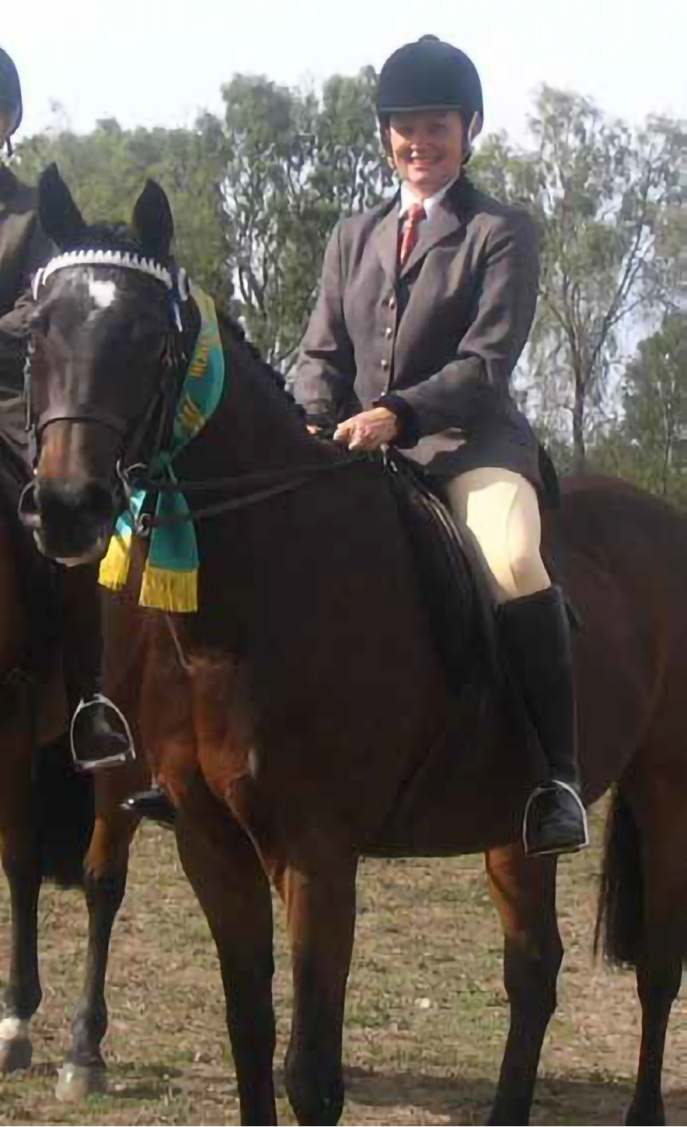
Vicki on her horse Oaklands Park Bentley in 2013 not long before retiring from the show ring.
What are the biggest differences between practising today and when you started in 1974?
The biggest differences between practising today and 1974 is of course the pace of practice brought about by the efficiencies of technology. On a societal level, there appears more violence and of course drug use. There is no doubt that bad behaviour wasn’t spoken about in earlier days, but I still believe it is worse now. Whether it is in the family situation or elsewhere, people have no hesitation in telling you off – they don’t hold back with complete strangers – so, of course, this transfers to the family.
Parenting has also changed. In the early days, fathers accepted that mothers parented children – that was their job. This meant that custody cases usually only arose if there some deficiency in the mother’s parenting ability. Otherwise, the discussion around parenting arrangements was mum agreeing to dad seeing the kids every second weekend and when he wasn’t working on school holidays.
Marketing by lawyers has also changed a lot. It was not permitted when I started and doing a good job and word of mouth was the key to marketing. I cringe at some of the lawyer marketing I see today. According to Google, every lawyer is an expert. Unfortunately, the public find out the hard way. QLS accreditation and word of mouth are the most reliable source today.
What do you think about artificial intelligence being used in law?
I am certainly no expert on ChatGPT or artificial intelligence in the law. But I always think anything that doesn’t engage the brain is fraught with danger. Like the way our precedents work, I think AI can be used in law, but the person using it must engage their brain to make sure it suits the client!
What do you think it takes to be a good family lawyer – is it different to when you started?
A good family lawyer in earlier times is not much different to now. Be a good listener, give advice as you see it based on the law, not what your client wants to hear, encourage compromise where appropriate and don’t fuel the anger.
What are the highlights of your nearly 50 years of practising family law?
It certainly was a highlight to receive awards and be recognised with an OAM for my contribution to the law generally. However, the thing that always brings me joy is the gratitude of clients whom we, as lawyers, have been able to assist at the worst time of their lives. They never forget which is very rewarding.
I have one client for whom I acted in a parenting matter in the late 80s in which there were allegations of sexual abuse against her children. She lives away from Rockhampton now but every year upon returning at Christmas to visit family she drops in a gift for me and has done so for more than 20 years.
Credit: Excerpt from the original article featured in FLPA Roundatable Magazine Winter 2023